Project
Gee-Force One
2023

On this page Overview
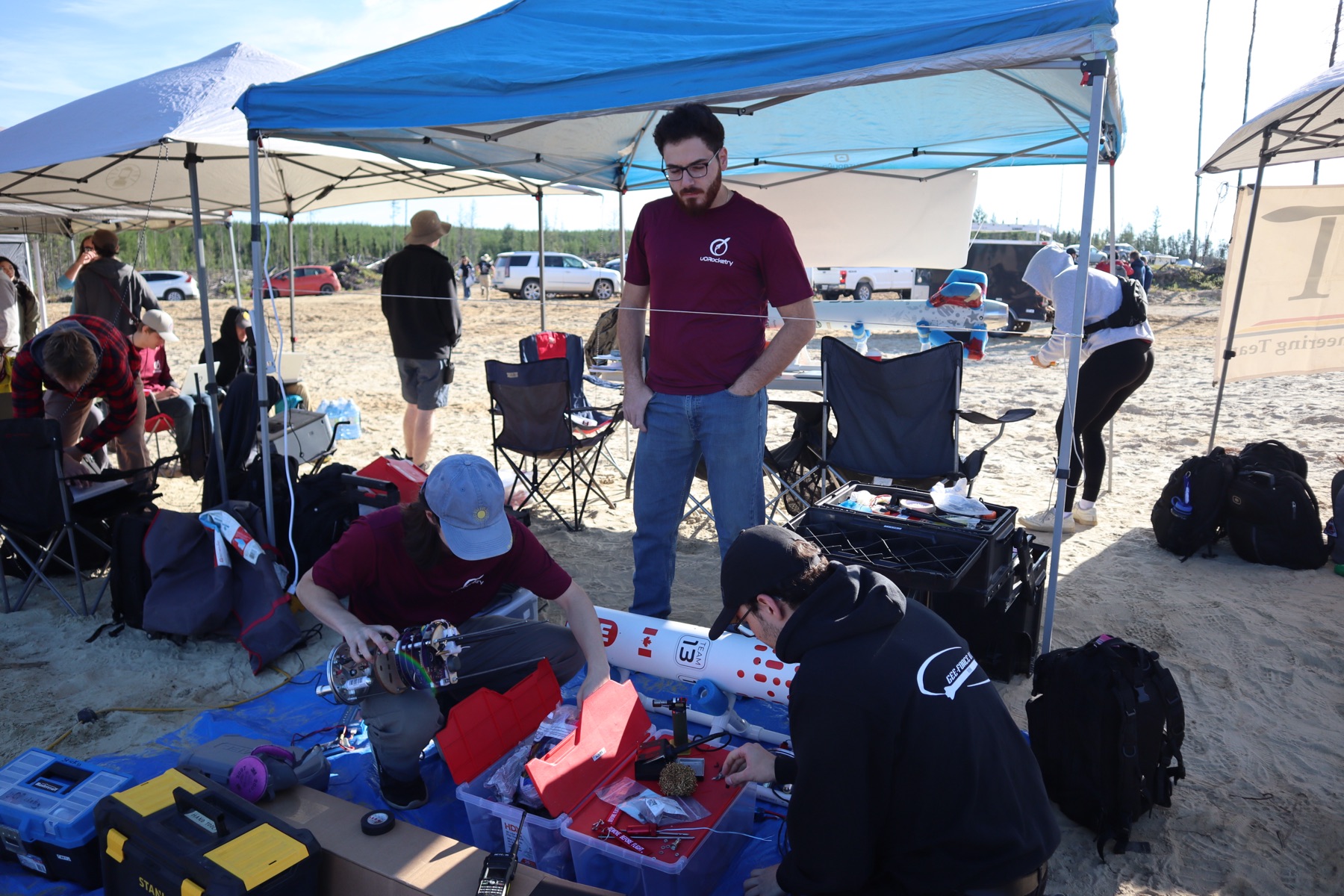
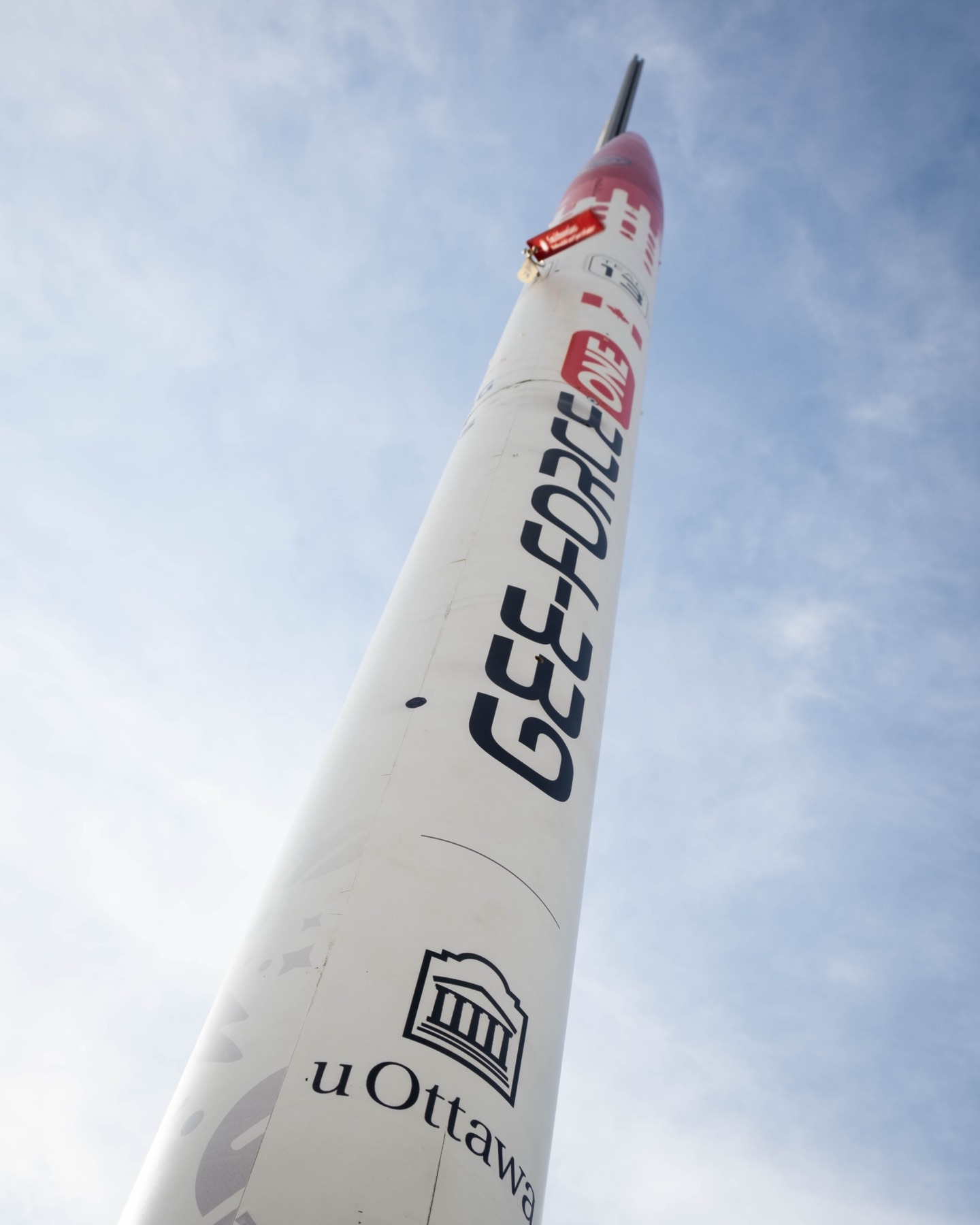
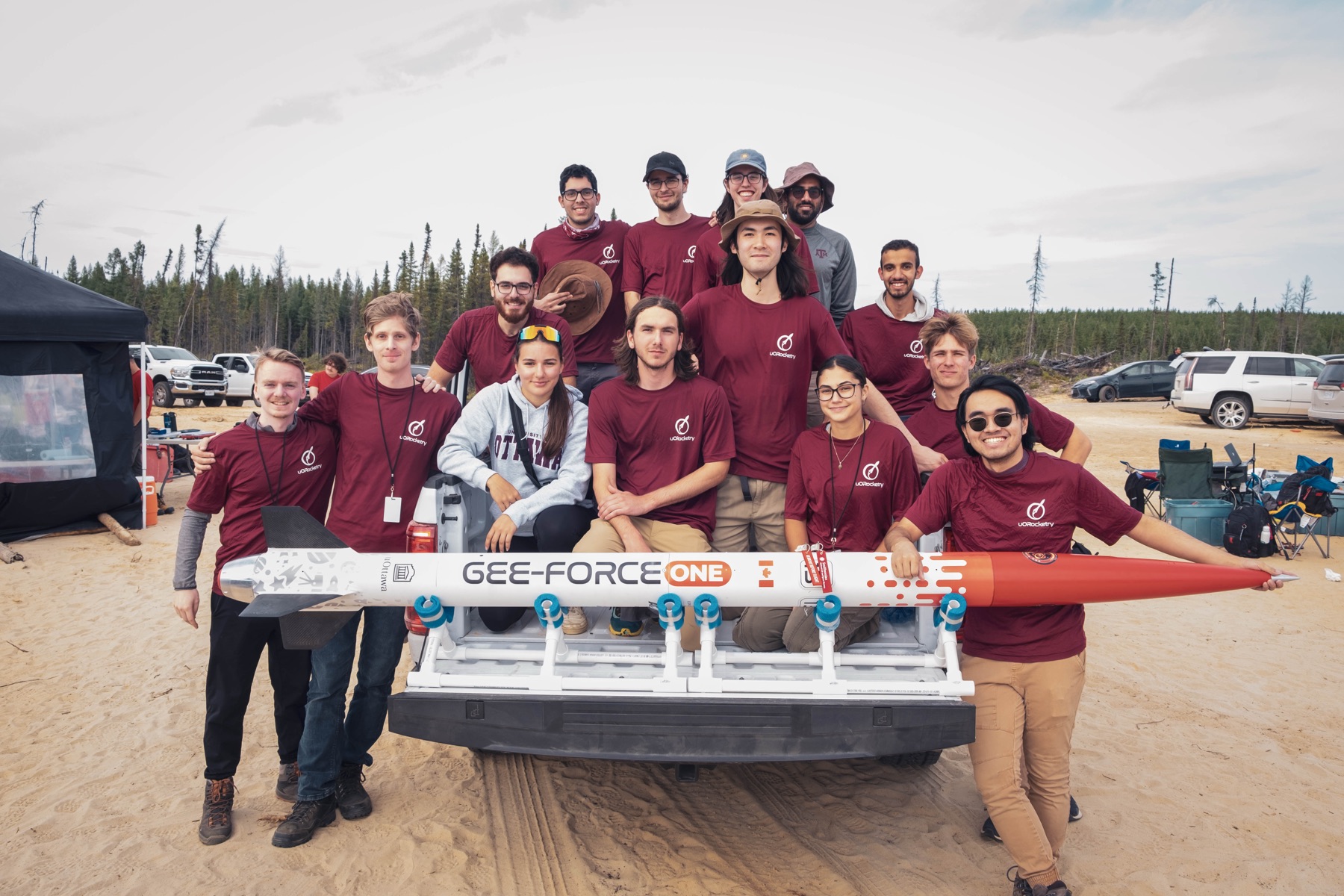
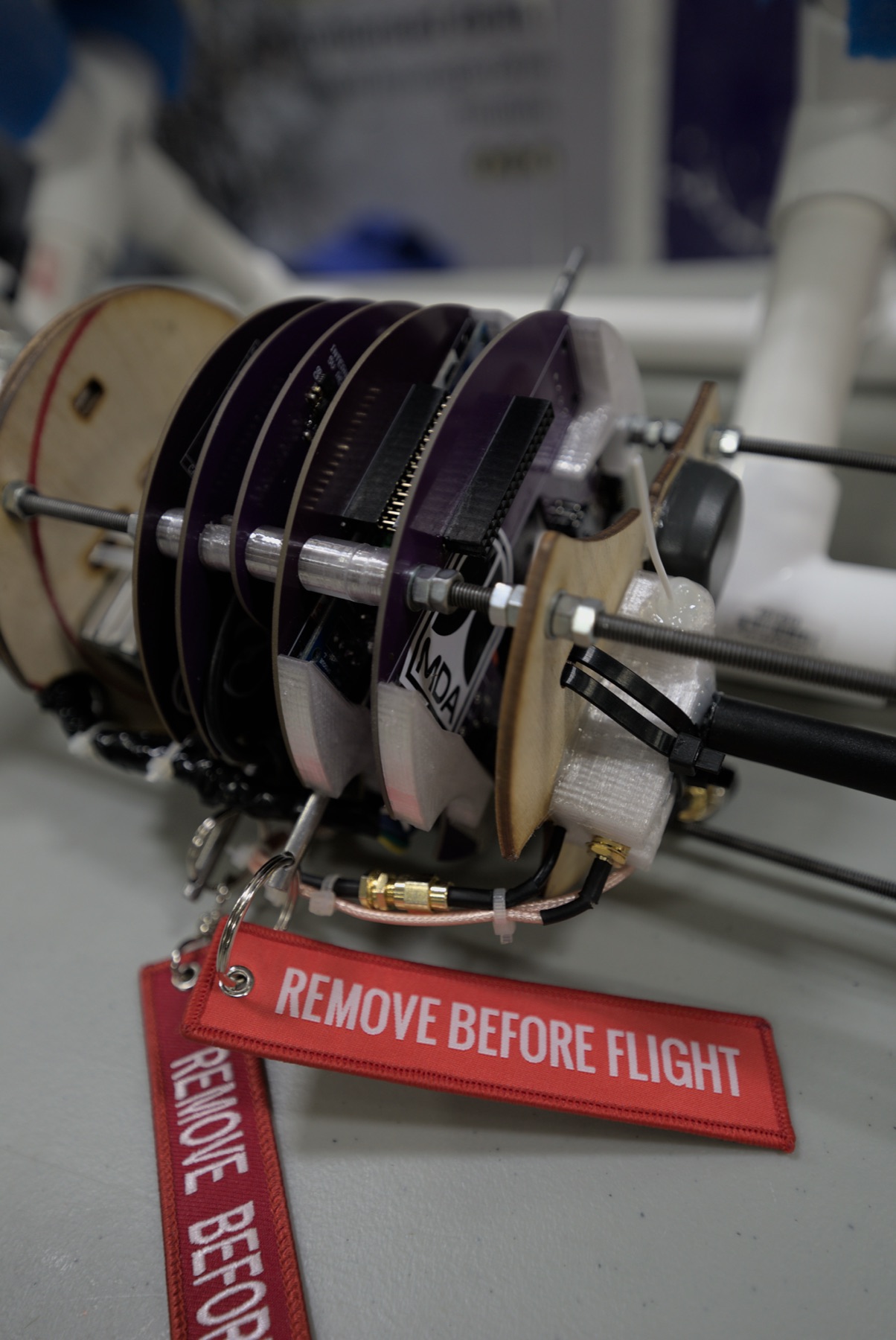
At Launch Canada 2023, we launched our tallest rocket yet, Gee-Force One. Some highlights of this rocket are HYDRA, the advanced SRAD avionics system featuring custom PCBs; and our brand-new telemetry ground station.
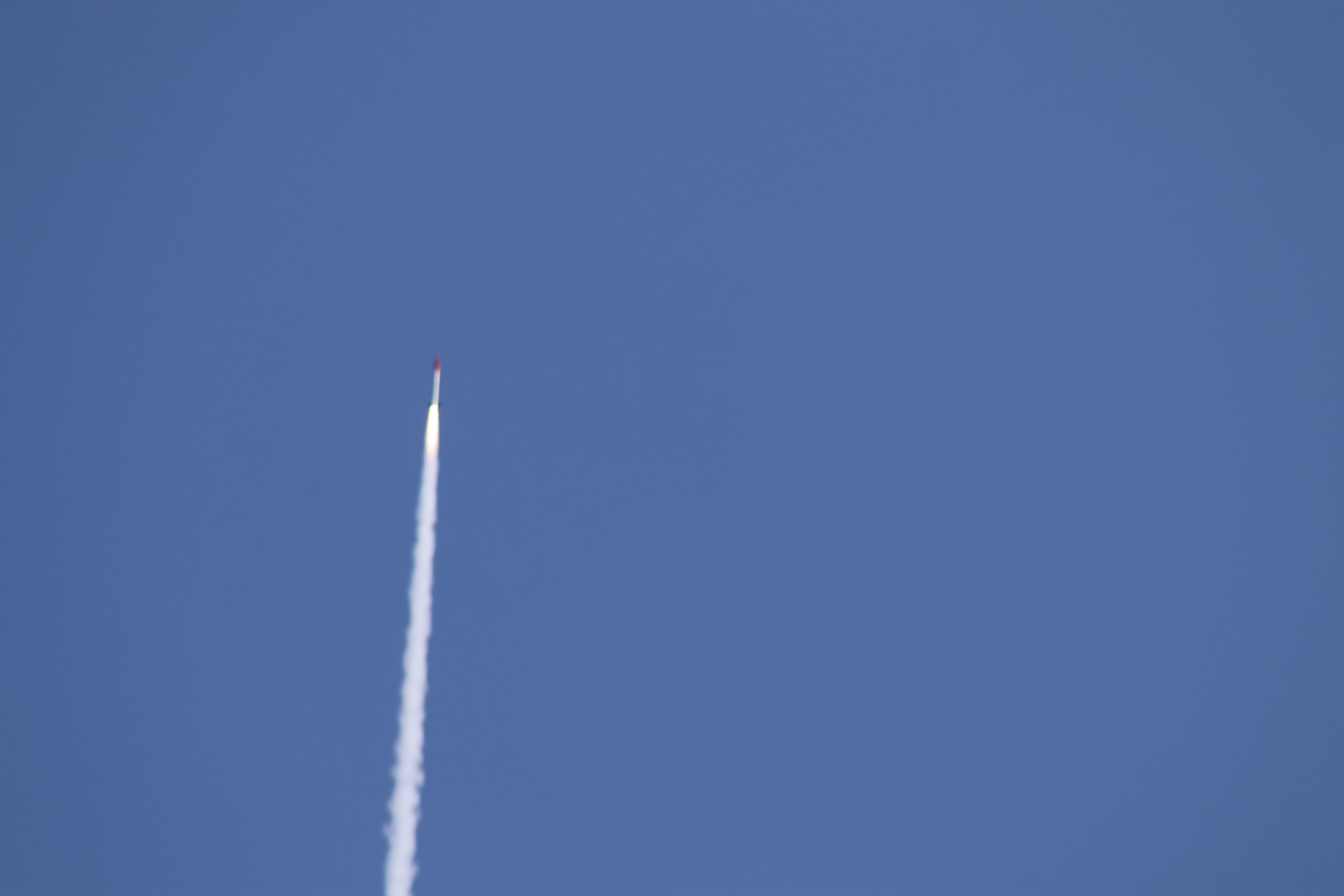
At the launch, our main parachute unfortunately deployed at apogee due to a miswiring issue with our COTS flight computer. Despite this, the overall flight of Gee-Force One was successful!
Not only was our maximum velocity (Mach 1.76) extremely close to our predicted value (Mach 1.84), but our SRAD avionics system HYDRA also performed as intended, logging more than 6 million data points! Another major success was the collection of footage during the flight, which was extremely helpful in post-flight inspections and analysis. We were even awarded 5th place in the Basic Launch Category!
Gee-Force One is currently on display in the John McEntyre Team Space in the STEM Complex (STM).
System architecture

- Nose cone
-
- COTS filament-wound G12 fiberglass
- 5:1 Von Kármán profile
- 6061-T6 aluminum external tip
- Body tube
-
- COTS filament-wound G12 fiberglass
- Avionics bay
-
- M5 x 0.8 Class 8.8 threaded rods
- Birch plywood stabilizer plate
- Recovery
-
- COTS filament-wound G12 fiberglass ring
- 6061-T6 aluminum bulkheads
- CO2 dual deployment for SRAD drogue and main parachutes
- Motor mount
-
- Carbon-fiber coupler stiffness ring
- 6061-T6 aluminum bulkhead
- ABS assembly alignment ring
- Fins
-
- Four clipped-delta carbon-fiber fins
- Boat tail
-
- 6061-T6 aluminum
- Avionics (HYDRA V2)
-
- Power board with a protected battery voltage rail
- Logic board for sensor updates, telemetry, and SD-card logging
- Communication board connecting the telemetry radio to the CAN bus
- Recovery board with one RRC3+ and one SRAD ejection circuit
- Independent Featherweight GPS tracker
- Key switches
- Ground station
-
- Proxy receives and decodes radio messages
- Web-based GUI displays real-time flight information
Designed system characteristics

- Propulsion
-
- COTS Cesaroni N5800 Pro98-6GXL C-Star solid motor
- Predicted apogee
-
- 7,027 m (23,055 ft)
- Maximum velocity
-
- Mach 1.8
- Maximum acceleration
-
- 232 m/s²
- Dimensions
-
- Height 3.12 m
- Diameter 156.72 mm
- Center of gravity
-
- Full 2,061 mm from the nose tip
- Empty 1,898 mm from the nose tip
- Center of pressure
-
- Minimum 2,349 mm from the nose tip
- Maximum 2,488 mm from the nose tip
- Mass
-
- Dry 22.7 kg
- Wet 31.8 kg
- Stability margin
-
- Minimum 1.8 cal
- Maximum 3.9 cal
- Launch configuration
-
- 5.18 m rail
- Rail departure velocity 42 m/s
- Nominal rail angle 84°
- Maximum wind velocity 8.3 m/s
- Motor performance
-
- Average thrust 5,774.1 N
- Peak thrust 8,034.6 N
- Initial thrust 6,701.3 N
- Total impulse 20,145.7 Ns
- Burn time 3.5 s
- Specific impulse 228 s
- Fin geometry
-
- Four fins mounted 25 mm above the fin-tube base
- Root chord 280 mm
- Span 160 mm
- Tip chord 120 mm
- Sweep distance 160 mm
- Parachute descent speed
-
- Drogue 36 m/s at apogee +3 s
- Main 4.6 m/s at 450 m AGL
- Peak deployment force
-
- Drogue 800 N at apogee +3 s
- Main 3,000 N at 0.2 s after opening at 450 m AGL
Post-flight assessment
- Apogee
-
- 7,244 m (23,768 ft)
- Maximum velocity
-
- Mach 1.76
- Structure
-
- Nose cone, body tubes, couplers, and bulkheads intact
- All shear pins cleanly sheared
- Top launch lug damaged; bottom launch lug intact
- Motor casing and fins intact
- Slight chips on one fin from recovery; flyable
- Some vinyl-wrap heat damage near the nose cone; flyable
Project gallery